Angelic Tales • Neakivaizdinis Vilnius

Angelic Tales

The Otherworldly Beings of Vilnius

It is said that every city has its own spirit. We can feel the spirit of Vilnius as we walk through the streets of the Old Town, wander into courtyards or look up at church towers. Sometimes it may seem that something is protecting us here. Perhaps angels? Perched on rooftops, hidden in works of art, or simply living in people’s hearts.

It would probably be hard to find someone who doesn’t like angels. We all secretly hope that we have our own guardian angel, and we often mention them in songs – they run with their lips, carry kisses, or the angel of sadness finds its way back to you…

This route invites you to embark on a journey following in the footsteps of angels in Vilnius – from ancient sacred images to contemporary artistic interpretations. Together, let’s discover the stories of the winged guardians of Vilnius, along with the history of the people and their values.

Route map

1. The Angel of Užupis

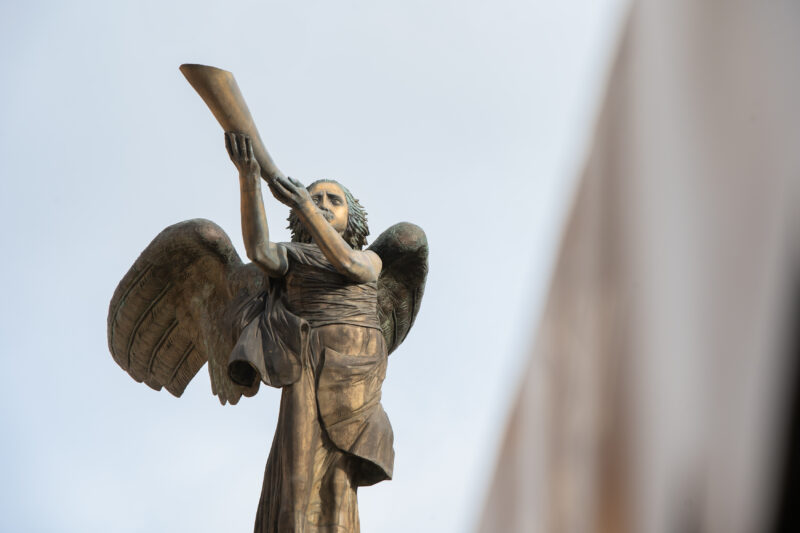
For a long time, Užupis was a neglected, gloomy and far from prestigious district of Vilnius. However, with the winds of change blowing, new residents began to move in, houses were renovated, building facades were refurbished and neglected courtyards were restored. The proactive newcomers were led by Zenonas Šteinys, a prominent member of the community, artist, cartoonist, director and animator. After his death, the community decided to commemorate him, and it was Romas Vilčiauskas, a sculptor from Užupis, who came up with the idea of an angel.

The sculptor failed to complete the angel by the agreed-upon date. Still, he managed to use his cunning creativity to weave himself out of the situation by presenting an egg at the sculpture’s unveiling ceremony, from which the angel of Užupis would soon ‘hatch’. The sculpture ‘Angel of Užupis’ was finally erected in 2002 to mark the fifth anniversary of the Independence of Užupis.

Standing in the square where a shrine once honoured the Crucified Christ, the Angel of Užupis blows a trumpet and proclaims to the world the rebirth of the Užupis district and the freedom of creativity. This bronze angel has become one of the main symbols of Užupis. If you would like to converse with the angel, go ahead! Simply scan the QR code at the bottom of the sculpture, and the angel will talk – it’s part of the ‘Talking Sculptures’ initiative.

2. The St Michael the Archangel Weathervane

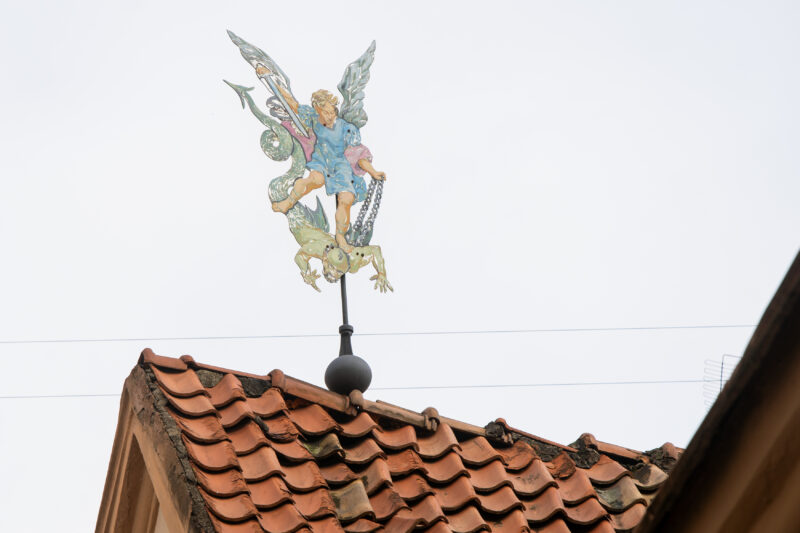
Walking down Pilies Street, turn into Literatų Street and look up above the rooftops. On the right, you will see one of the most colourful weather vanes in Vilnius, depicting the Archangel Michael with Lucifer chained at his feet.

Four decades ago, Bronius Uogintas-Pūkis, a painter who had lived in this house, discovered the old tin weather vane in the attic. It is believed that this is the actual weather vane that stood on the roof of this house, which was mentioned in historical sources at the end of the 18th century. It is believed that it was made and painted by Vilnius craftsmen based on the famous painting ‘Archangel Michael’ by Italian painter Guido Reni. 

The sculptor Kęstutis Musteikis made an exact replica of the old weather vane out of stainless steel at his own expense. Vidas Drėgva painted it based on the painting kept in Rome.

From the 17th century, Literatų Street was known as St Michael’s Cross Street, as it led directly to St Michael the Archangel Church.

3. The Angels of St Johns’ Church

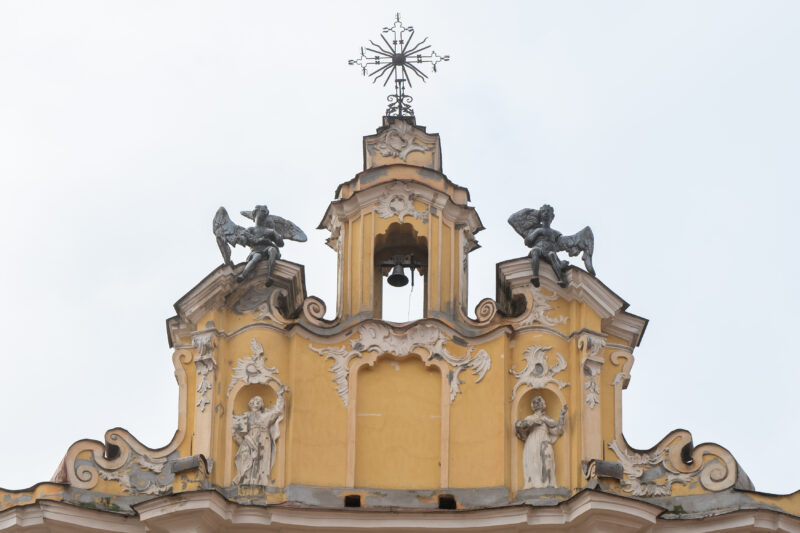
Enter one of the largest transitional courtyards in the Old Town. At the end of the 18th century, a botanical garden and orangery were established on this plot covering 300 square metres. Walking into the middle of the courtyard, you will see a magnificent view of the eastern facade of St. Johns’ Church (dedicated to both John the Baptist and John the Evangelist). The church acquired its current ornate late Baroque appearance after a fire in 1737. The church acquired its current ornate late Baroque appearance after a fire in 1737. It was rebuilt by John Christoph Glaubitz, the most famous architect in Vilnius at the time. Look up and gaze at the top of the church, which is not visible from Pilies Street due to its narrowness. Can you see the two black angels there?

One legend goes like this… Once upon a time, the angels grew tired of sitting in one place. After asking God to release them from this duty, they were given the task of finding the happiest and unhappiest citizens of the city. Initially, it seemed blatantly obvious that the happiest would naturally be the ruler, but they searched for the unhappiest one for a long time; they ran themselves ragged and finally found a beggar sleeping on the street. When they happily presented him to God, the poor man woke up and was very indignant at being disturbed. He called the angels ignorant and declared that he was the happiest man because he had neither wealth nor family, so he lived as he pleased, walking his own path, free as the wind. And, of course, it then turned out that the ruler was actually not so happy because of the great responsibility weighing on his shoulders. Disappointed and realising that they knew nothing about people and their strange ways, the angels remained on the roof of the church.

4. The Angel with a Coat of Arms

Bernardinų Street connects the churches dedicated to St. Anne and St. Bernardine with Pilies Street. The street began to take shape during the Gothic period, with most of the buildings dating from the Baroque and Classicist periods, featuring courtyards in the style of the 17th and 18th centuries. A large part of the houses on Bernardinų Street are architectural and historical monuments. 

The corner house at Bernardinų g. 6 / Šiltadaržio g. surrounds an elongated, enclosed courtyard. The oldest part of the house, which is Gothic in style, was built in the 16th century. The building consists of two floors, and the façade is decorated with Baroque ornamentation. For almost three hundred years, the building belonged to the Vilnius Cathedral Chapter, and during the Soviet era, it housed the Sanitary Education Centre. 

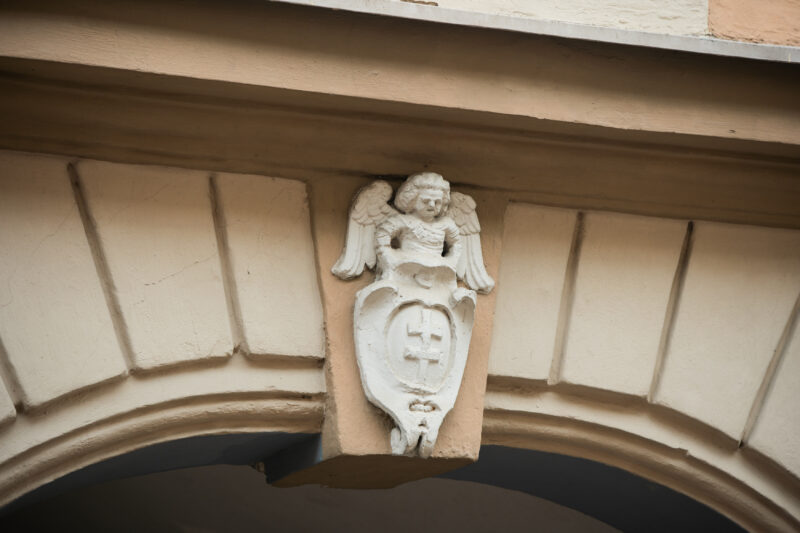
Above the entrance, there is an interesting plastic decorative element – an angel holding a coat of arms with a double cross in the centre. The origin of these heraldic symbols and the identity of the coat of arms remain unclear. We can only hope that this mystery will be solved in the future.

5. St Matthew with an Angel

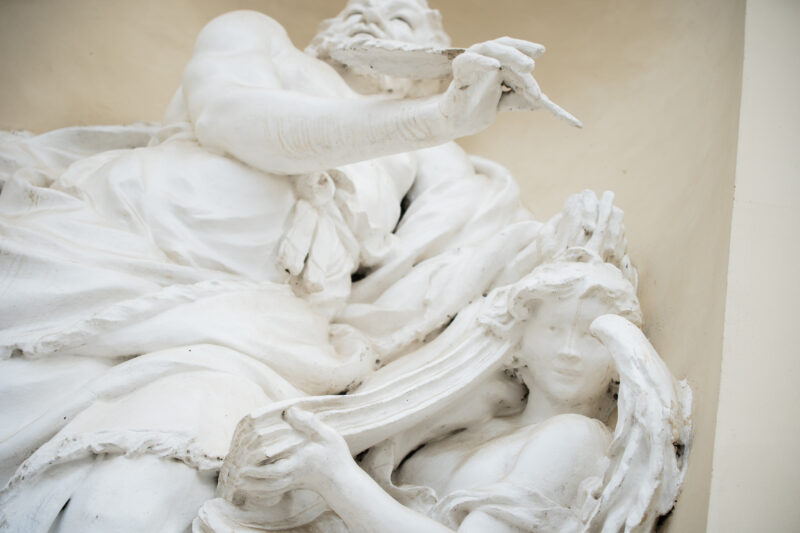
The first things that catch the eye on the facade of the Cathedral, designed by Laurynas Gucevičius, are the six sculptures. The sculptures were created by the Italian artist Thommaso Righi. The niches on the sides of the front facade feature Abraham and Moses, the most important figures of the Old Testament. Behind the portico columns, closer to the entrance to the sanctuary, are sculptures of the four evangelists, the heralds of the New Testament. These saints are easily identifiable because they have their own symbolic signs (from left to right): Matthew is depicted with an angel, Mark with a lion, Luke with an ox, and John with an eagle. 

Before meeting Jesus, Matthew worked as a tax collector. When Jesus called Matthew while he was sitting at the customs office, Matthew got up and followed him, leaving everything behind except one thing – a pen. And Matthew nobly used the talents God had given him by becoming the first person to write down Jesus’ teachings. 

The oldest image of Saint Matthew, accompanied by an angel, survives in a 6th-century mosaic in Ravenna, Italy. However, until the 14th century, the evangelist was more commonly portrayed as the symbolic angel himself. The artistic traditions of later centuries developed the relationship between the evangelist and his heavenly guide, who assisted him in writing the Gospel. The angel might appear as a child clutching Matthew’s inkwell, standing beside the evangelist to observe his work, or even guiding his writing hand.

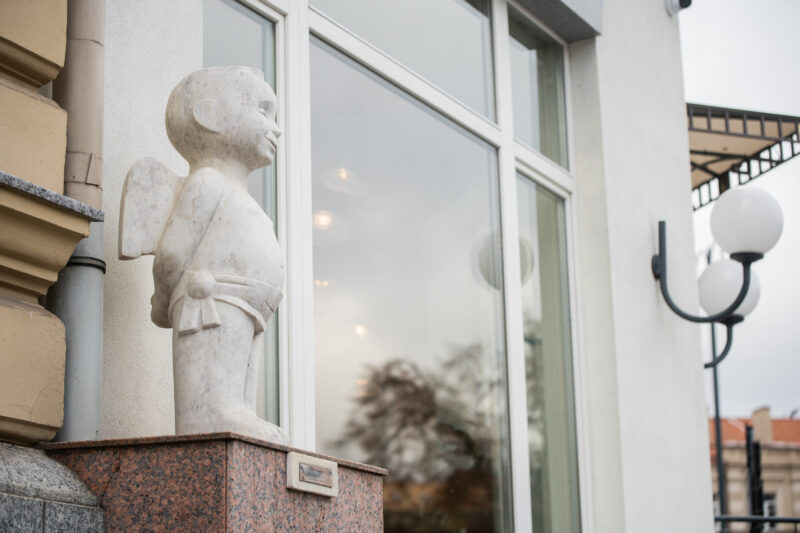
6. The Small Angel of Vilnius

In 2004, Vilnius City Council asked the sculptor to create something that would divert the anger of citizens with a proclivity towards vandalism away from constantly damaged telephone booths, shelters at public transport stops, and other city property. So, Ramoška created a consciously provocative sculpture of an animal – made out of a combination of metal structures and plaster, the ‘Žydras ožys’ sculpture was installed on Gediminas Avenue. The name translates literally as ‘The Pale Blue Goat’; in Lithuanian, these words carry alternative derogatory meanings. As expected, the sculpture was vandalised within a few days. This then led the sculptor to come up with the idea of creating something that locals would not dare to ‘harm’ – angels, so this is how a new symbol of Vilnius was born. Ramoška’s angels can not only be found in Lithuania but also in many other countries – and even as far away as in the Himalayas!

7. Cupid

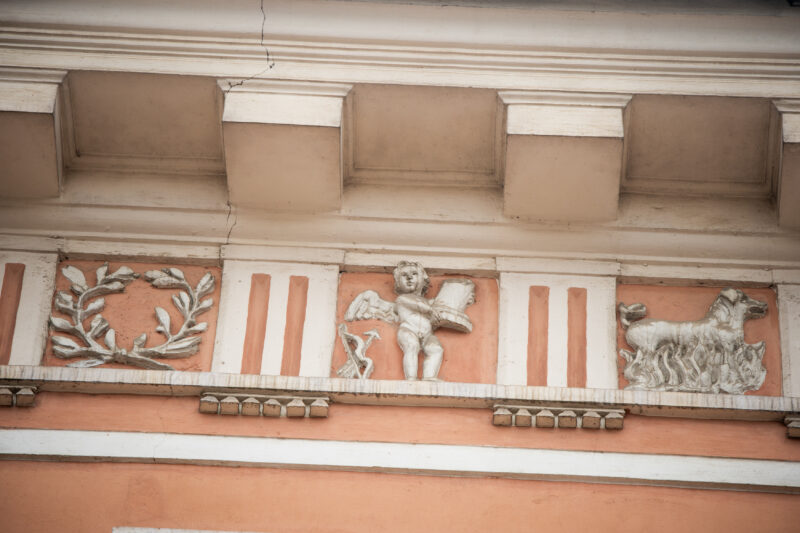
The palace at the intersection of Vokiečių and Trakų Streets passed in 1789 from the Tyzenhauz family of nobles to Teodora Fitinhofienė, the wife of a general; this is why the building is sometimes called the Tyzenhauz Palace and at other times is referred to as the Fitinhof Palace. In 1790, the general’s wife had the palace reconstructed according to a design by architect Marcin Knakfus, giving it an early classicist appearance.

The most ornate part of the palace façade is the frieze, which features compositions of objects, animals, people, demigods, and gods. These classic images from antiquity range from laurel wreaths to weapons, altars, and pegasi. Classicists loved, used, and reproduced them. 

Among the abundance of symbols, try to find a little angel figure. Here’s a hint. Take a look at the middle of the building, above the entrance to the courtyard. This chubby chap is most likely Cupid, the ancient Roman god of love. He is usually depicted with a bow and arrows. However, here he has put his bow and arrows aside and is holding the base of a column in his hands. Isn’t that a rather heavy object for such a tiny angel?

8. The Angel in the Tunnel of Love

In the 16th century, Ulrich Hosius (Ulryk Hozjusz) – the castellan of Vilnius, administrator of the mint, and builder of the first Green Bridge – lived in the house at Vokiečių g. 24. 

Step into the courtyard, and on your left, you will get a good view of the bell tower of the Evangelical Lutheran Church. Looking up and turning to the right, on the wall of the second floor, you will notice a map of Lithuania’s outline made of exposed bricks. 

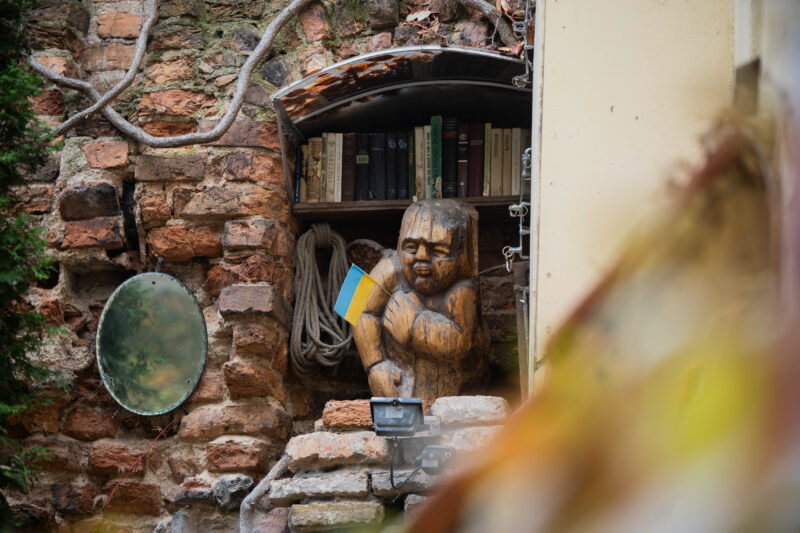
This courtyard also features a charming dwarf passage (sometimes called the ‘Tunnel of Love’). Venture through the low tunnel and turn your head to the right, looking up. You will see a hidden wooden angel who has already spotted you and is eagerly keeping watch over you. 

9. The Angels of the Palm Branches

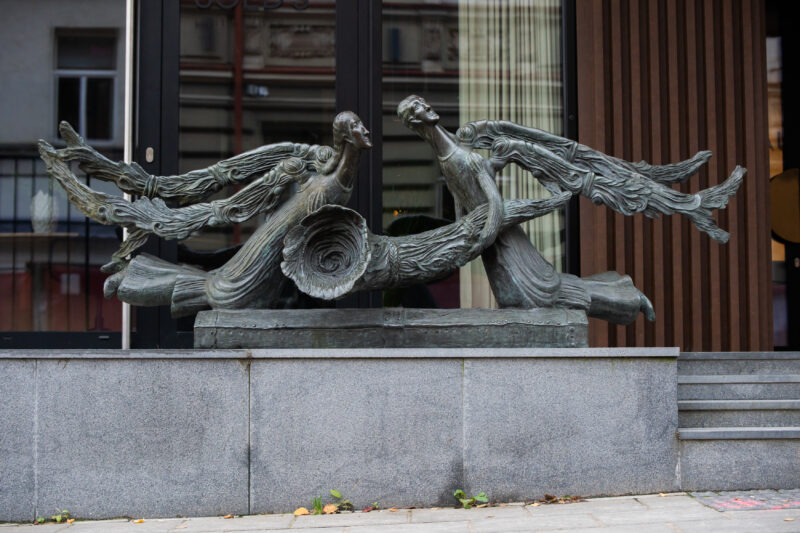
Since 2004, the building at J. Basanavičiaus g. 4A has been home to collector Edmundas Armoška’s Maldžio Art Gallery. In 2022, the building underwent renovation and is now home to the Gallery 4A apartments. When selling the building, E. Armoška set one condition: Audrius Liaudanskas’ sculpture ‘Verbų angelai’ (‘Angels of the Palm Branches’) at the entrance must remain in place. According to the collector, it is an integral part not only of the building but also of the street. 

Angels are a frequent motif in the work of sculptor A. Liaudanskas. The artist mainly creates small bronze sculptures. The statuette of the well-known and coveted awards for the film industry, ‘Silver Crane’ (‘Sidabrinė gervė’) – the equivalent of the Lithuanian Oscars – is the work of Andrius Liaudanskas.

1 9

Skaidrė 119

Castellan’s House

Plačiau